
Presentation at the 48th AEDEAN Conference in Vitoria-Gasteiz (12-14 Nov 2025)
At the 48th AEDEAN Conference in Vitoria-Gasteiz (12–14 November), I took part in several activities connected to our Beyond Postmemory Project.
I chaired a roundtable with our PhD students Elvira Aguilera and Cristina Franco, Dr Sara Martín, Dr Nick Spengler and Dr David Owen, where we discussed the intersections of war, trauma and ecology through the lens of environmental postmemory in contemporary Anglophone literature and culture. The contributions examined a range of literary and cultural texts, discussing memory as something carried by bodies, landscapes and fractured temporalities marked by war, and reflecting on how literature and culture can bear witness to trauma beyond the human.
I also participated in the Modern and Contemporary Literature panel, where our PhD students Elvira Aguilera and Cristina Franco, Dr David Owen and I presented individual papers that extend ongoing work within the project.
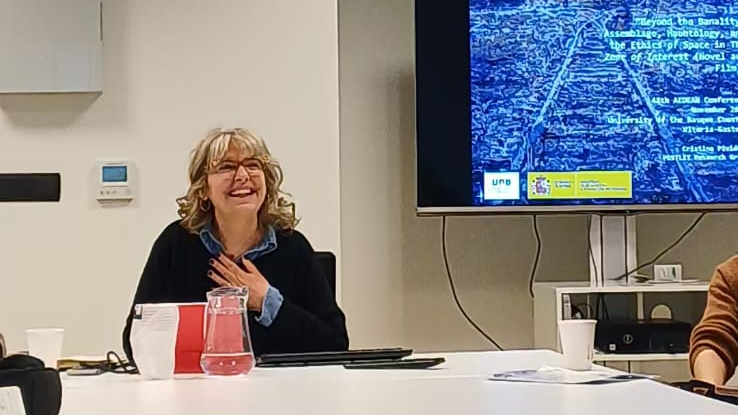
My paper, “Beyond the Banality: Assemblage, Hauntology, and the Ethics of Space in The Zone of Interest (Novel and Film)”, revisited Hannah Arendt’s notion of the “banality of evil” by shifting attention from psychology to the structural and spatial conditions that make violence possible. Drawing on Martin Amis’s The Zone of Interest and Jonathan Glazer’s film adaptation, I explored how atrocity is embedded in everyday routines and in the spatial and sensorial fabric of the concentration camp. Working with Manuel DeLanda’s “assemblage theory” and Mark Fisher’s idea of “hauntology,” I suggested that evil is not only psychological but also materially and atmospherically distributed, inviting an ethical reading of war and genocide that takes space, form and systemic complicity not just as neutral backdrops to individual agency but as crucial coordinates for understanding how violence is organised and normalised.