⚖️Jornada Cooperació per la Justícia Gobal, Fundació Autònoma Solidària
🗓️24 November 2025, 9-14h
📍Sala de Juntes, Facultat de Filosofia i Lletres
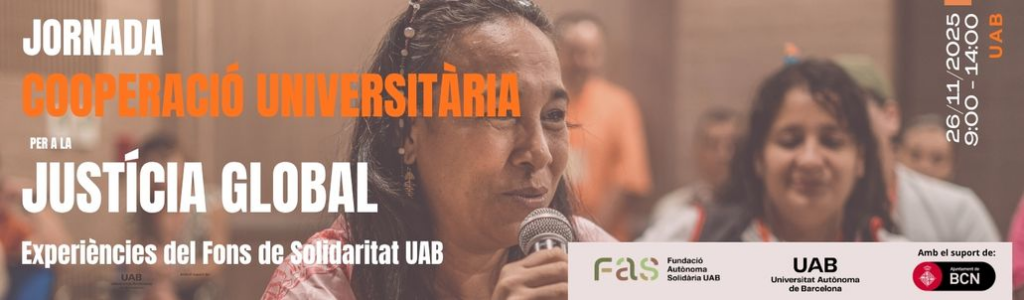
I was glad to take part in the Jornada de Cooperació Universitària per la Justícia Global by presenting the activites carried out within Words Beyond War, a FAS-funded project that set out to connect university teaching with the lived experience of refugee and displaced people in Catalonia. Our aim was to create a space where students, staff, and the community could come together to reflect on war, memory, and displacement through critical and collaborative conversation.
At the heart of the project was the idea that contemporary war literature and theatre are not just disciplinary fields. They can also be tools for building connections and rethinking how we talk about conflict. Together with our research teams—G4RoC (Group for the Representation of Conflict) and POSTLIT (Beyond Postmemory Research Group)—we worked closely with KUDWA, a refugee-led association in Barcelona that supports young migrants and refugees, to bring this idea to life.
Over spring 2025, we ran three public activities:
a Storytelling Session (28 March), where KUDWA facilitators led BA, MA, and PhD students through reflective, hands-on exercises around war, migration, and memory; a Role-Play Workshop (25 April), where participants stepped into the roles of asylum seekers, border agents, journalists and more, to explore how power shapes whose stories get heard; and Singing Survival (12 June), a session featuring a talk by Dr Andrea Bellot (URV) and a performance by her TFG student Laura Jarque, where we combined academic insight with a live performance of songs from the play Ruined by Lynn Nottage to reflect on gendered violence and the aftermath of war.
The experience was genuinely transformative. Students became active participants rather than passive listeners; refugee voices moved from the margins to the centre, with many taking on the role of co-educators; and the classroom became a shared space for dialogue, creativity, and critical thought.
In the end, the project did what we hoped it would: it built a real, ongoing collaboration between the university and the refugee community through our work with KUDWA, and it showed that academic spaces can host powerful, reparative encounters that can shift how war is remembered, studied, and addressed in public life.